Building a Brand House Google Can't Blow Down
Featuring Kelly Sheppard, Structured Data and Brand Optimisation Specialist
Building a brand that cuts through the noise requires a clear voice, a strong digital foundation, and the right partners by your side. Here Kelly unpacks how brands can define their core perspective, build long-term momentum, and leverage multi-channel digital branding to drive tangible growth.
Three little pigs, three little companies
You know the story, but this one is slightly different. Three pigs leave home to build a company each, and a big bad wolf turns up. In this version, the wolf is Google. The houses are your brand, sitting out on the internet and being tested constantly by Google, AI and other search engines.
Straw: website + Google Business Profile. The first pig builds a nice-looking website, sets up a Google Business Profile and puts his feet up. Google looks for citations, reviews and third-party mentions. It finds none, so it can’t confirm a single fact about him. One huff and the house is gone.
Sticks: good content + social media. The second pig works much harder. Good content, regular social posts, a Google Business Profile. It looks solid, but nothing external holds it down and nobody is vouching for him. Google huffs, puffs, and the house comes down.
Bricks: deep foundations. The third pig takes the longest. He has a technically sound website, good reviews, backlinks and excellent content. He adds structured data, links to his Companies House record and other citations like Crunchbase, and gets involved in industry conversations. His company is tied to a network of other people’s verified opinions, so the wolf can huff all day.
The moral: it’s not the walls that keep the wolf out, it’s what your foundations are tied to.
The three questions Google asks about your brand
Before Google fully trusts a brand, it quietly asks three questions, in this order.
1. Does your brand exist?
Your brand probably has several names: the brand name, the company name Limited, the company name Ltd, nicknames and abbreviations. Capitalisation counts too. Google has to work out that every mention, legal entity, directory listing, video, social comment and LinkedIn post is the same company. If there are too many variations, or other companies use your name, Google can’t attribute any authority to you because it isn’t sure it’s really you.
Between 96% and 99% of the web isn’t indexed because search engines crawl trillions of pages but index only a tiny fraction, to save space and filter out spam and duplicate content, as well as content on the dark web. Your website is treated as not worth indexing until you prove otherwise.
2. Can your brand be trusted?
Google may know your name, but does it know what you do?
No consistency + no proof + no mentions = no trust.
Trust signals include:
- Awards and industry recognition
- Certifications, accreditations and qualifications
- Well-written articles that show E-E-A-T
- Showcasing your staff
The Search Console symptom here is Crawled – currently not indexed: either thin or duplicate content, or a trust issue. Google found the pages and decided not to index them. It doesn’t just affect small companies. One site we looked at once had over 500,000 pages in this state.
3. Who vouches for your brand?
Google needs evidence from other people:
- Staff, Google and critic reviews
- Guest posts
- Social media mentions
- Linked brand mentions in articles (backlinks)
- Unlinked brand mentions in articles
- Directory listings in relevant industries
Rebrands & Migrations
During a rebrand or website migration, the authority doesn’t disappear, it waits until Google can attribute it to the right entity again. In one website migration (a merger of two well-established brands, migrated in November 2025), the legal entity scored 1,388 in February 2026. Then it dropped to 0 overnight. We worked on the legal and brand entities so Google could see they were now the same company, and in July the panel jumped back up, higher than before.
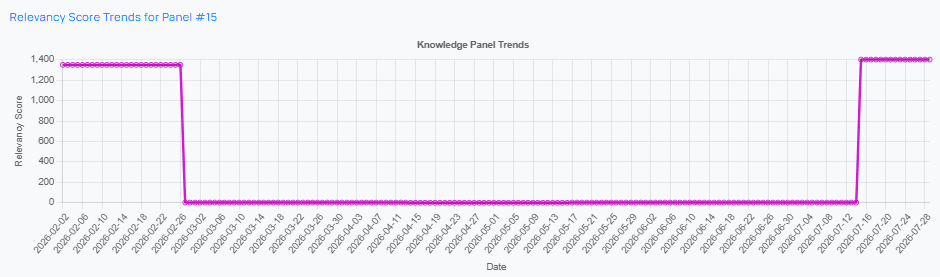
The brand name only had a brief dip because it was consistent. Merging two legal entities is a different ball game, and if old sources still mention the old company name or website, things don’t match up and Google becomes uncertain.
New website? New name? Google has to re-earn its trust in you. Done badly, that means months or years of lost visibility. Done properly, with good SEO support, it tends to recover well.
What a brick-house brand looks like day to day
- Same business name everywhere
- Good reviews and reputation
- People talking about you, even without linking to you
- Consistent name, address, phone number and website address
- Clear, consistent facts: founding dates, places and founders, credentials, achievements, qualifications, certifications and awards
- Matching information on your website and Wikipedia/Wikidata, LinkedIn and Crunchbase
- Regular updates, because freshness signals matter
- Visible authors and team members, who need authority too
- Mentions in industry news, publications and forums
- A technically sound website with minimal crawling and indexing issues (AKA good technical SEO)
- Semantic triples describing who you are and what you do: subject, predicate, object. Your brand, sells, this product. This author, wrote, that article.
Where structured data fits
Structured data is the behind-the-scenes code that ties all of this together. It’s a map for Google to follow, and a translator between your business and search engines. It has to work hand in hand with your content. It can:
- Reduce ambiguity between brand names, company names and legal names
- Help Google understand, or correct, the facts in your Knowledge Panel if you already have one
- Give search engines more facts about your company, products and services
- Improve visibility in AI
Building a strong brand entity takes time, and for a small brand it can take a year or more just to get noticed. The good news is that once you’re in Google’s Knowledge Graph you go from straw to sticks, and the early work pays off, you’ll hopefully have created a strong brick brand!
Which house are you living in?
A stronger brand entity means you outrank competitors who haven’t done this work. A weaker one means you’re invisible, or Google is showing something inaccurate about you and you don’t know. Trust online translates into trust from real people buying your products and services.
Most business owners have no idea which house they’re living in, and you can’t fix a problem you can’t see. Google will keep testing every business, whether you like it or not. The only question is whether it finds straw, sticks or bricks.
Want to know exactly where your brand stands? Get in touch with us to book a brand entity audit today!
Ready to build your house out of bricks?
Fill the form below to get instant access to our GeoTalks Playbook.
© GeoBrand. All rights reserved.